The face
The area that holds the shape. Leave it open so the light can describe it.
 HINGE
Form studies for curious hands.
Explore the space inside a fold.
The area that holds the shape. Leave it open so the light can describe it.
The narrow place that connects two different directions.
A small system, made readable by its parts.
Three planes meet around one narrow connection.
Follow the outer edges of the three faces.
The yellow joint is the shared line between them.
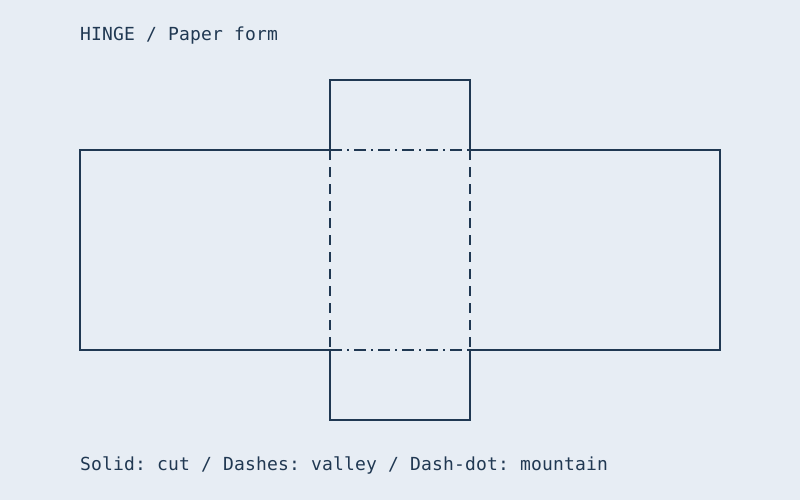
The outside faces rise to meet. Follow the dash-and-dot line on the net.
The inside faces make a shallow valley. Follow the dashed line on the net.
| Mark | Action | Result |
|---|---|---|
| Solid line | Cut the outer boundary | One continuous shape |
| Dashed line | Fold away | A valley |
| Dash and dot | Fold toward you | A ridge |
The downloadable net is an art exercise. Print on paper, trim the outline and crease by hand. It is not a load-bearing part or a manufacturing drawing.
Start with ordinary paper you can fold comfortably by hand. The illustration does not specify structural strength or material tolerances.
Yes. The SVG contains editable lines and shapes. Keep a copy of the original before changing the fold positions.
A printable net and a concise folding guide.